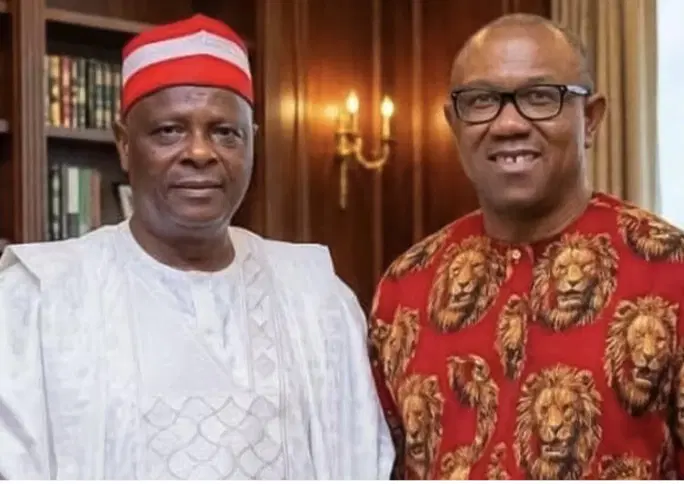
The exit of Peter Obi and Rabiu Musa Kwankwaso from the African Democratic Congress (ADC) is far more than a routine resignation. It represents a defining moment—one that compels Nigerians to re-examine the judiciary’s role, the fragility of political parties, and the unsettling sense that democratic outcomes may be drifting away from the ballot box.
The news spread like wildfire in dry harmattan air. Within moments, it moved from newsroom alerts to animated roadside conversations: Peter Obi and Rabiu Musa Kwankwaso had resigned from the ADC.
In a newsroom in Abuja, a young political reporter froze mid-sentence, eyes fixed on his phone. Only weeks earlier, he had spoken optimistically about opposition coalitions and the ADC’s potential to reshape Nigeria’s political future. Now, he leaned back and quietly asked, “So… where does that leave us now?”
A simple question—but in Nigerian politics, rarely a simple answer.
This is not just another political exit. It is a turning point that raises urgent questions about judicial influence, party instability, and a democracy that increasingly feels removed from voters’ direct control.
In Nigerian politics, timing is seldom accidental. While the departure of both men would be significant under any circumstances, it becomes even more telling when viewed alongside recent Supreme Court rulings that have intensified internal party disputes.
What appears on the surface as political repositioning begins to look like a calculated move—an escape from a looming legal and electoral trap.
The narrative quickly shifts beyond individual political ambitions to broader institutional weaknesses. What some see is not just a party in crisis, but signs of deeper structural issues—what could even be interpreted as systemic political engineering.
Nigeria may not simply be witnessing the collapse of a party, but a critical phase in its democratic evolution. Legal uncertainty, political maneuvering, and institutional fragility are converging in ways that could shape the path to the 2027 general elections.
Peter Obi and Rabiu Musa Kwankwaso are not fringe players. They command significant political followings, regional influence, and ideological appeal. Their simultaneous exit signals that something fundamental has shifted within the political landscape.
Official explanations point to familiar issues—leadership disputes, lack of transparency, and internal crises. But when two major contenders independently conclude that a party is no longer viable, it signals more than internal disagreement. It reflects a deeper erosion of confidence in both the party and the broader system.
To fully grasp the situation, attention must shift to the courts. The evolving stance of the Supreme Court on party disputes has transformed political participation.
Today, internal party legitimacy is no longer procedural—it is decisive. A candidate can win elections and still be removed if the process that produced them is later judged flawed.
For a party already divided into factions, this reality creates serious uncertainty. Questions abound:
Which faction has the authority to conduct primaries?
Which leadership will the courts recognize?
Which candidate will ultimately be deemed legitimate?
For politicians of Obi and Kwankwaso’s stature, these are not theoretical concerns—they are risks that could end entire political ambitions.
Seen from this perspective, their resignations appear less like isolated decisions and more like strategic responses to the same threat. Staying in the ADC would mean navigating a legal minefield—parallel primaries, conflicting candidates, and the constant risk of judicial nullification.
Their departure, therefore, can be interpreted as self-preservation.
But this leads to a deeper concern: if leading political figures cannot trust a party to carry their ambitions through a complete electoral cycle, what does that reveal about the system itself?
The situation becomes even more complex with the involvement of the federal government. The Attorney-General’s move to seek the dissolution of the ADC has fueled suspicions among critics that legal processes may be increasingly used as tools in political competition.
Even without definitive proof, the convergence of legal action, political timing, and party instability creates a perception that is hard to ignore—and in politics, perception is powerful.
A worrying trend is emerging: internal party conflicts are no longer just internal—they can become instruments of political elimination.
In a healthy democracy, disputes are resolved through dialogue and internal mechanisms, with courts as a last resort. But when judicial rulings determine political legitimacy, party crises evolve into strategic vulnerabilities.
Nigeria’s multiparty system is often praised as a sign of democratic strength. However, the ADC crisis challenges this assumption.
A strong democracy is not measured by the number of parties, but by their stability and coherence. Fragile parties—plagued by factionalism and legal battles—struggle to fulfill their role.
The exit of two major figures sends a signal to other politicians: some platforms may be too unstable to trust. The likely outcome is a shift toward a few “safe” parties—those with the institutional strength to survive legal scrutiny.
But as political competition narrows, democracy weakens.
Amid these high-level calculations, ordinary voters risk being sidelined. The situation reinforces a troubling belief—that even top politicians must constantly adjust to unpredictable rules, and that electoral outcomes may not fully reflect voter choice.
When trust declines, participation drops. Democracy risks becoming more symbolic than substantive.
As Nigeria moves toward the 2027 elections, the consequences of this moment will become clearer. Obi and Kwankwaso’s search for a more stable platform will influence alliances, reshape opposition dynamics, and affect voter expectations.
Yet, critical questions remain:
Can Nigeria build stable political parties capable of sustaining real competition?
Can the judiciary maintain neutrality in politically sensitive cases?
Can citizens regain confidence in the electoral system?
Nigeria’s democracy stands at a crossroads—and what happens next may define its future.