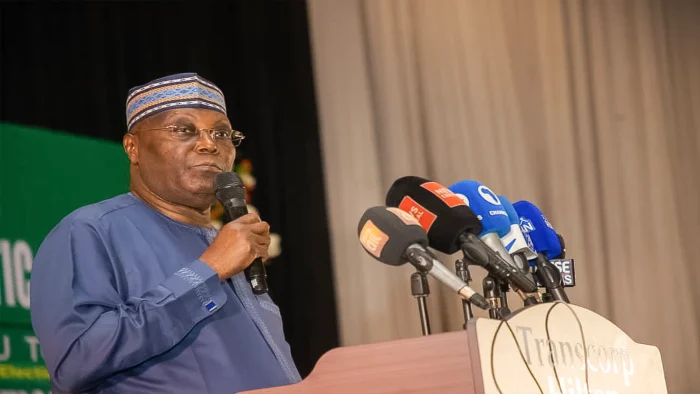
Former Vice President of Nigeria and Presidential Candidate of the African Democratic Congress (ADC), Atiku Abubakar has condemned the allocation of ₦1.08 trillion to the Federal Cooperative College, Oji River, Enugu State, for the execution of 2,791 capital projects across the 36 states and the Federal Capital Territory, describing it as a major distortion of the 2026 Appropriation Act.
In a statement issued by his Senior Special Assistant on Public Communication, Phrank Shaibu, Atiku praised civic organisation Tracka for uncovering what he called one of the most disturbing examples of budget manipulation under the administration of President Bola Ahmed Tinubu.
According to Atiku, the revelations contradict the Federal Government’s claims of fiscal discipline, especially as Nigerians continue to bear the burden of subsidy removal, increased taxes and rising public debt.
He questioned why a federal institution established to promote cooperative education would be assigned responsibility for implementing thousands of projects nationwide, including roads, drainage systems, solar streetlights, markets, football pitches, dialysis centres, ambulances, water schemes, recycling plants and empowerment programmes.
Atiku described the arrangement as illogical and inconsistent with public finance principles, asking who approved the projects, under what legal framework the college was given such responsibilities, and who would be accountable for their execution.
He further accused the Tinubu administration of treating the national treasury as a personal reserve rather than a public trust, arguing that a government calling for sacrifices from citizens cannot justify channeling over ₦1.08 trillion through an institution that lacks both the statutory mandate and institutional capacity to execute projects of such magnitude.
The former vice president maintained that the allocation undermines the government’s claims of fighting waste and promoting fiscal responsibility, insisting that the budget arrangement appears “less like governance and more like a blueprint to defraud Nigerians.”