ENUGU — Concern is mounting over the fate of more than 500 residents of Southeast Nigeria battling various forms of kidney-related diseases, many of whom are struggling to afford life-saving treatment, particularly dialysis.
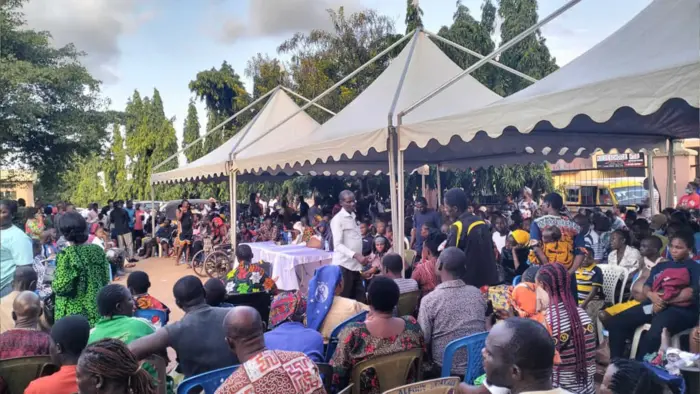
The concern came to the fore on Friday when the premises of the Enugu State University Teaching Hospital (ESUTH), Parklane, Enugu, became a gathering point for kidney disease patients and their families seeking financial assistance to continue treatment.
The gathering followed an appeal by philanthropist, Emmanuel Onyeka Okoh, popularly known as Okwulora, who had earlier used social media to invite people suffering from kidney-related ailments to the hospital to receive support.
Three large canopies erected within the hospital premises were filled with patients and their relatives. Among them were adults and children displaying various symptoms, including swollen legs, faces and stomachs.
While some patients were brought in wheelchairs because they could barely walk, others sat under the canopies or beneath trees, visibly distressed and in pain.
The situation attracted the attention of the Presidential Candidate of the National Democratic Congress (NDC) in the 2027 general elections, Mr Peter Obi, who paid a surprise visit to the hospital.
Obi expressed shock at the number of people gathered and said he was deeply moved by the scale of the kidney disease crisis.
“I didn’t know we have such number of people that have been knocked down by kidney problems. I am really touched by this development,” he said.
Obi promised to support the patients through the platform established by Okwulora, noting that it would be difficult to reach out to each victim individually.
‘I Have Sold Everything to Save Lives’
Speaking during the visit, Okwulora said he had made significant personal sacrifices in an effort to help people affected by kidney disease and other medical emergencies in the region.
According to him, he had sold his house, lands and other valuables to raise funds for patients who could not afford treatment.
He disclosed that he had spent about N15 million at Parklane Hospital alone this year to assist patients and settle medical bills.
“It is sad. Look at them. They are hopeless and helpless and some of them, if they don’t get dialysis, might not even see Sunday,” Okwulora said.
He explained that the assistance being distributed was intended to provide patients with funds for dialysis for at least one or two months while further support was sought.
Okwulora, who also disclosed that he lives with complications associated with diabetes, said his personal experience had strengthened his resolve to help others facing serious health challenges.
“Myself, I’m diabetic. I’m having organ problems as well as a result of diabetes. Last time, I almost amputated my leg. I did skin grafting. So I am close to what they are facing,” he said.
He described the kidney disease situation as a “pandemic”, expressing particular concern over the number of children between six and 10 years who are reportedly affected.
“These children of 6 to 10 years have not taken alcohol before. They have not smoked before. Yet, their future is hanging and bleak due to this illness,” he said.
Appeal to Southeast Governors
Okwulora appealed to governors across the Southeast, wealthy individuals and political leaders to urgently intervene in the crisis.
He argued that government investment in roads and other infrastructure would have little meaning if residents were unable to remain healthy enough to benefit from them.
He said several patients had died while waiting for medical assistance, adding that he had repeatedly appealed to government officials and wealthy individuals in the region without receiving the level of intervention required.
According to him, Udi and Ezeagu areas of Enugu State appear to be among the communities badly affected.
He recalled that he conducted health screening for more than 3,500 people at Michael Okpara Square last year as part of efforts to identify health challenges within the population.
Experts Call for Urgent Government Intervention
A Clinical Psychologist, Dr Sydney Igwe, called for urgent government intervention, particularly in making kidney treatment more affordable and accessible.
Igwe said weekly dialysis was beyond the financial capacity of many Nigerian families and urged authorities to support patients requiring dialysis and kidney transplants.
“There is no way an average family can afford weekly dialysis because of the cost,” he said.
He also called for increased public awareness of the causes and prevention of kidney disease.
The Chairman of the Nigeria Medical Association (NMA), Enugu State, Dr Chima Edoga, urged residents to take greater responsibility for their health and be cautious about their dietary and medication habits.
Edoga identified poorly controlled hypertension, poorly controlled diabetes and untreated urinary tract infections as some of the risk factors associated with kidney failure.
He also warned against the use of unregulated herbal preparations that may contain toxic substances, as well as some skin-lightening products containing harmful substances such as mercury.
He advised residents to drink adequate amounts of water, particularly during hot weather, illness or strenuous physical activity, while people with heart or kidney conditions should follow their doctors’ recommendations on fluid intake.
Edoga further urged Nigerians to regularly check their blood pressure, screen for diabetes and maintain good blood glucose control where necessary.
He also warned against the prolonged or inappropriate use of non-steroidal anti-inflammatory drugs (NSAIDs) and other potentially harmful medications.
Early Detection Can Save Lives
Former NMA Chairman in Enugu State and Community Health Physician, Dr Sunday Okafor, said kidney disease should not always be regarded as an inevitable condition.
According to him, many diseases that damage the kidneys can be prevented, detected early and treated before they progress to kidney failure.
He explained that Chronic Kidney Disease (CKD) occurs when kidney function progressively declines, while kidney failure develops when the kidneys become severely impaired and can no longer adequately sustain life without kidney replacement therapy.
“Not everyone with kidney disease will develop kidney failure. Early detection and appropriate treatment can substantially slow or sometimes prevent progression to kidney failure,” Okafor said.
He, however, expressed concern about the financial burden of dialysis on Nigerian families.
According to him, dialysis currently costs approximately N50,000 to N80,000 per session, although charges may vary among facilities.
At those rates, he estimated that a patient requiring regular dialysis could spend as much as N12.8 million annually.
Okafor recalled that the Federal Government introduced a dialysis subsidy programme in 2025, under which the cost of a session was reduced from about N50,000 to N12,000 at participating federal tertiary hospitals.
He said the programme was initially introduced at selected centres and was subsequently reported by the Federal Ministry of Health and Social Welfare to be operating in 11 federal tertiary institutions.
However, he advised patients to confirm the current subsidy status, eligibility requirements and applicable charges directly with participating hospitals because the programmes and coverage could change.
Nigeria Faces Kidney-Care Infrastructure Gap
Okafor also raised concerns about the country’s limited kidney-care infrastructure relative to its population.
He cited the 2023 International Society of Nephrology Global Kidney Health Atlas, which reported approximately 0.80 haemodialysis centres per million population and only about 0.02 peritoneal dialysis centres per million population in Nigeria.
The figures, he said, highlight the need for greater investment in kidney-care infrastructure, early screening, preventive healthcare and affordable treatment.
For the hundreds of patients who gathered at ESUTH on Friday, however, the issue remains immediate: access to treatment could mean the difference between life and death.
As Okwulora appealed for more support, the gathering served as a stark reminder that beyond infrastructure and development projects, thousands of Nigerians are struggling daily to afford the basic medical care needed to stay alive.