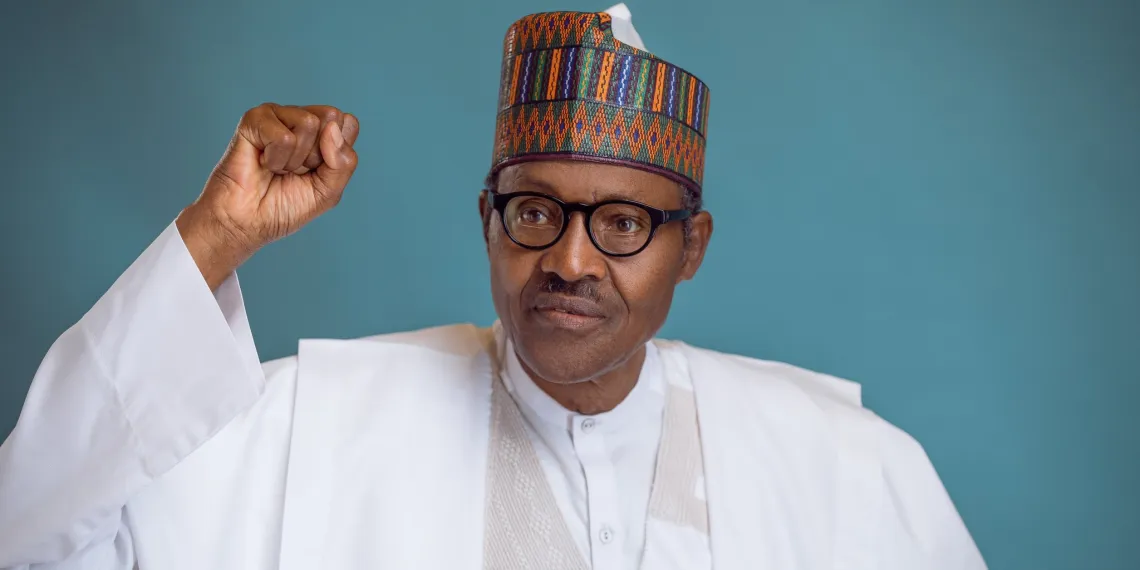
Mr. Buhari passed away on Sunday at a hospital in London, according to his spokesperson.
Muhammadu Buhari, Former Nigerian President, Dies at 82 in London
LONDON — Muhammadu Buhari, Nigeria’s former president and military head of state, has died at the age of 82. His death was announced on Sunday by his longtime spokesperson, Garba Shehu.
Shehu, in a message posted on X (formerly Twitter), said the former leader passed away at a clinic in London after weeks of medical care.
“The family of the former president has announced the passing of Muhammadu Buhari, GCFR, this afternoon in a clinic in London. May Allah accept him in Aljannatul Firdaus, Amin,” Shehu wrote.
Sources indicate that Mr. Buhari had been in the UK since April for what was initially described as a routine medical check-up. His condition, however, reportedly worsened, resulting in an extended hospital stay until his passing.
A Life of Leadership and Controversy
Muhammadu Buhari served as Nigeria’s democratically elected president from 2015 to 2023, after previously ruling as a military head of state between 1984 and 1985. He stepped down on May 29, 2023, completing two constitutional terms.
Throughout his presidency, Mr. Buhari was known for frequently seeking medical treatment in the United Kingdom. Though his health reportedly improved after leaving office, it deteriorated again in April 2025.
Early Life and Education
Born on December 17, 1942, in Daura, Katsina State, Buhari was the 23rd child of his father, Adamu. He lost his father at a young age and was raised by his mother, Zulaiha.
He began his education in Daura and Maiduguri (1948–1952), continued at Katsina Middle School in 1953, and later attended Katsina Provincial Secondary School (now Government College, Katsina) from 1956 to 1961, earning the West African School Certificate.
He married Safinatu Yusuf in 1971, and after their separation in 1988, married Aisha Halilu in 1989. Buhari had ten children across both marriages.
Military Career
Buhari joined the Nigerian Army in 1961, receiving training at the Nigerian Military Training College in Kaduna and the Mons Officer Cadet School in England. He was commissioned as a Second Lieutenant in 1963.
He underwent further military training in the UK, India, and the United States, and held prominent roles such as:
- Military Governor of the North-Eastern State
- Federal Commissioner for Petroleum Resources
- Chairman of the Nigerian National Petroleum Corporation (NNPC)
- General Officer Commanding two major Army divisions
He became Head of State in December 1983 following a military coup but was ousted in a counter-coup in August 1985.
Political Journey
After Nigeria transitioned to democracy in 1999, Buhari entered partisan politics. He ran unsuccessfully for the presidency in 2003, 2007, and 2011.
In 2013, he played a pivotal role in forming the All Progressives Congress (APC), which merged several opposition parties. Running on an anti-corruption and reform platform, Buhari won the 2015 presidential election and secured a second term in 2019.
His tenure focused on fighting corruption, tackling insurgency, and investing in infrastructure. However, his administration was also criticized for worsening insecurity, economic struggles, and alleged human rights violations.
A Controversial Legacy
Mr. Buhari’s death brings to a close one of the most impactful political careers in Nigeria’s modern history. Loved by supporters for his discipline and integrity, and criticised by others for his governance style, his legacy remains deeply etched in Nigeria’s political and military narrative.