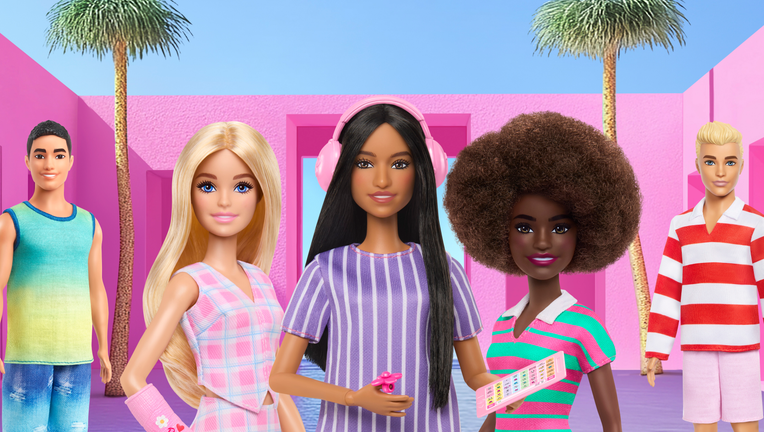
American multinational toy and entertainment company Mattel has introduced its first-ever autistic Barbie, further expanding its diversity-focused Fashionistas line. The collection already features dolls with Down syndrome, a blind Barbie, and Barbie and Ken figures with vitiligo.
Mattel said the new doll was developed over a period of more than 18 months in partnership with the Autistic Self Advocacy Network (ASAN), a nonprofit organization dedicated to promoting the rights and accurate media representation of autistic people. The company explained that the goal was to create a Barbie that reflects some of the ways autistic individuals experience and interact with the world.
Designing the doll presented unique challenges, as autism encompasses a broad spectrum of traits and behaviors, many of which are not outwardly visible. Representatives of the advocacy group involved in the project emphasized that autism does not look the same for everyone, noting that the doll highlights some commonly shared expressions rather than a single definition.
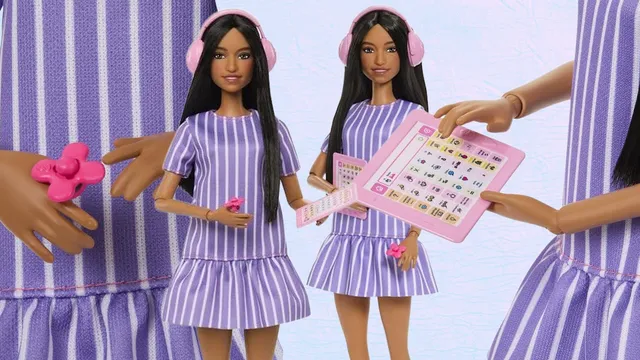
The autistic Barbie features eyes that shift slightly to the side, reflecting how some autistic individuals may avoid prolonged direct eye contact. The doll also has articulated elbows and wrists to acknowledge stimming behaviors, such as hand flapping or repetitive movements, which can help with sensory regulation or expressing excitement.
Special attention was given to the doll’s clothing, taking into account sensory sensitivities. While some autistic people prefer loose clothing due to fabric sensitivity, others favor tighter garments for body awareness. The final design includes an A-line dress with short sleeves and a flowing skirt to minimize fabric-to-skin contact, paired with flat shoes designed for comfort and stability.
Each doll comes with accessories including a pink finger-clip fidget spinner, noise-canceling headphones, and a pink tablet modeled after communication devices commonly used by autistic individuals who experience difficulty with speech.
The introduction of the autistic Barbie also provided an opportunity for broader representation within the autism community. The doll features facial characteristics inspired by women of Indian heritage, drawing from employee input and visual references.
In recent years, Mattel has continued to expand the Fashionistas line to reflect a wider range of lived experiences. New additions have included dolls representing Type 1 diabetes, prosthetic limbs, hearing aids, and a diverse range of body types, skin tones, and hair textures.
According to the US Centers for Disease Control and Prevention, autism affects approximately one in 31 eight-year-old children in the United States, with higher diagnosis rates among boys and among Black, Hispanic, Asian, and Pacific Islander children compared to white children.