Edo State Governor, Senator Monday Okpebholo, has announced the reintroduction of Edo languages into the state’s school curriculum, as part of his administration’s efforts to preserve the state’s cultural heritage and promote indigenous knowledge.
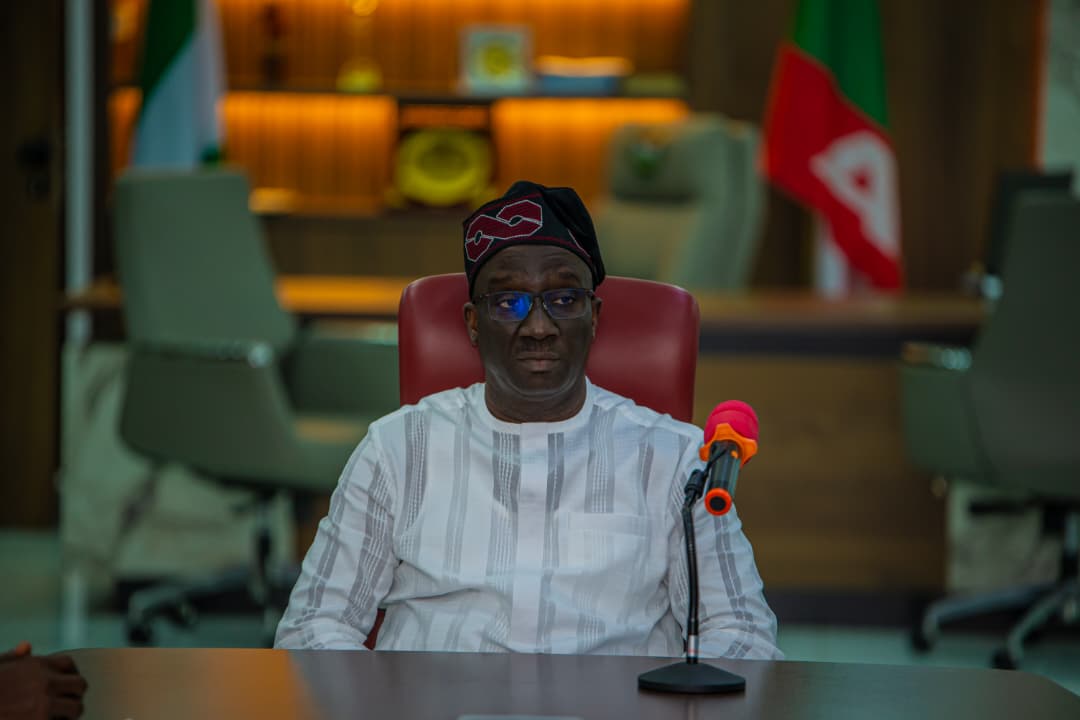
Governor Okpebholo made the announcement during a courtesy visit by the leadership of the Esan Okpa Initiative to Government House, Benin City.
President of the Esan Okpa Initiative, Rt. Hon. Mathew Egbadon, commended the Governor for his strides in education, infrastructure, and governance, while stressing the urgent need to protect and promote the Esan language.
“Protecting and advancing Esan language, culture and values is critical,” Egbadon said. “Esan language is disappearing because many of our people no longer speak it, and it is no longer taught in schools. Reintroducing it into the curriculum will align with the 2022 National Language Policy, which mandates the use of indigenous languages as the primary medium of instruction in the first six years of primary education.”
Egbadon, who led a delegation of technocrats, business leaders and community stakeholders, described the Esan Okpa Initiative as a non-partisan socio-cultural movement committed to the unity and progress of Esanland. He praised the Governor’s achievements, including Edo’s inclusion in the Federal Government’s ₦142 billion modern bus terminal project — the only state in the South-South to benefit.
“We have seen your work. New roads are being built, schools are being rehabilitated, and over 4,000 teachers have been regularised. You have returned Edo to the national development map,” he said.
He also called for support for independent power generation in Esanland through private investment models similar to Ossiomo and Azura, and advocated for agro-based industries and stronger security support in rural communities.
In response, Governor Okpebholo expressed gratitude to the Esan people, describing them as a “critical pillar” of his administration’s success. He disclosed that the Ministry of Education has been directed to intensify school rehabilitation across the state.
“We will continue massive renovation and fencing of schools, provide boreholes, toilets, seats and desks, and begin installing solar lights. We are also rolling out a school access programme that gives children hands-on computer experience,” he said.
On language preservation, the Governor stressed the importance of starting from the grassroots:
“We must start from home. We will reintroduce vernacular into our school system so that every tribe begins to learn and speak their language, ensuring that no language goes into extinction.”
Governor Okpebholo also reaffirmed his commitment to reviving Ambrose Alli University (AAU), describing its restoration as “a victory for the people.” He highlighted key projects across the state, including road construction, transportation, healthcare, and security reforms.
According to him, 50 Compressed Natural Gas (CNG) buses have been ordered to improve transportation across Edo’s three senatorial districts. In the health sector, 65 primary healthcare centres have been completed or rehabilitated.
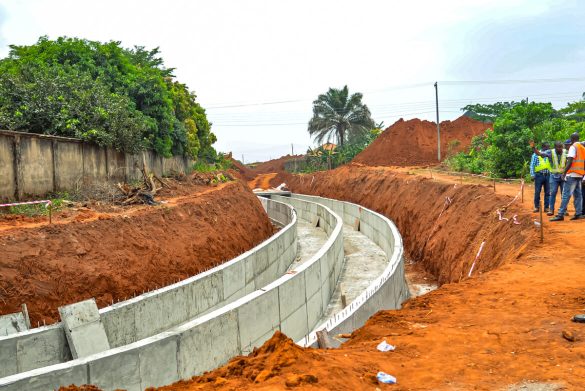
He added that work is ongoing on the Ekpoma–Uromi–Ubiaja Road, with compensation already being paid to affected property owners. Construction is expected to accelerate during the dry season, reducing travel time between Ekpoma and Auchi to about 35 minutes.
On security, the Governor revealed plans for decentralisation and increased personnel:
“We are working seriously on security. New equipment has been procured, and a new mobile barracks in the central district will soon be operational. We trained over 2,000 personnel and placed them on the government payroll, and we are considering engaging local hunters to strengthen community security,” he said.
Governor Okpebholo reiterated that his administration is focused on delivering legacy projects that will outlive his tenure.
“My concern is legacy — what we will leave behind for our people. That is the true essence of leadership,” he added.