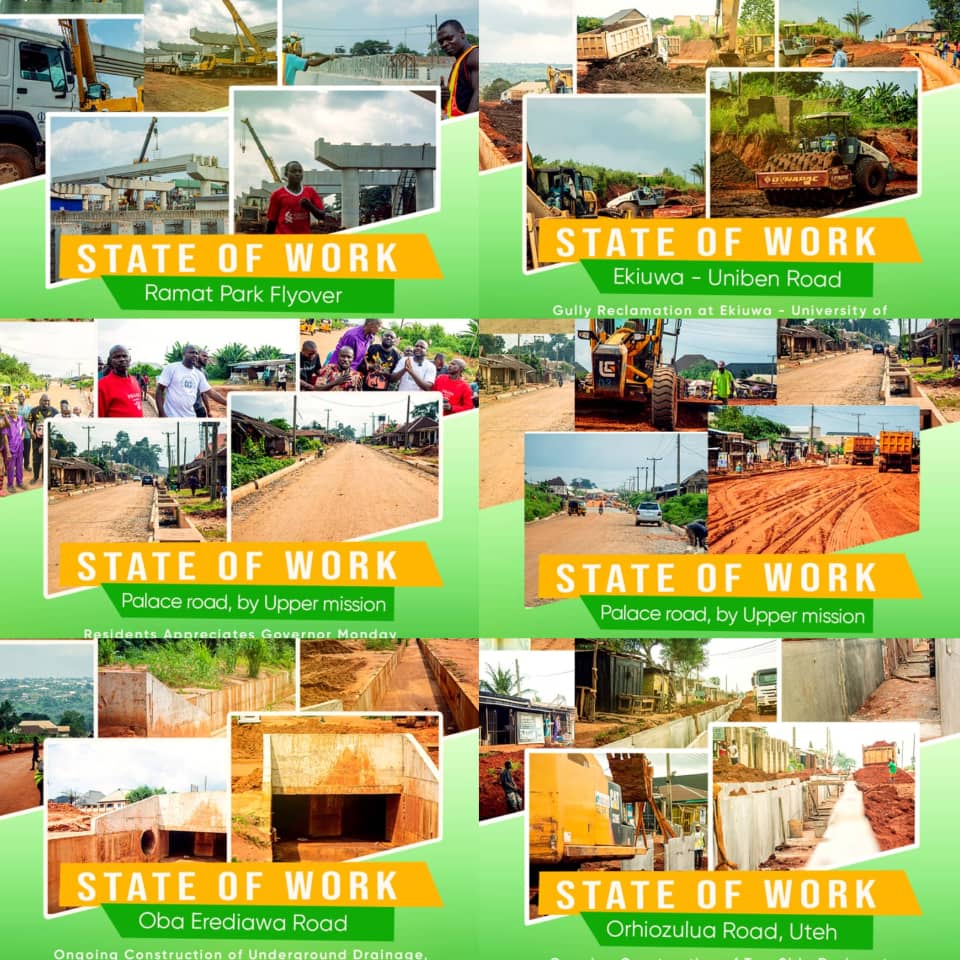
After eight agonizing years of stagnation under his predecessor, Edo State’s destiny in road infrastructure is finally taking shape. True, many federal roads across the state remain in disrepair, but Governor Monday Okpebholo has chosen action over blame. Rather than lament ownership or trade excuses, his administration is mobilizing heavy-duty trucks to sites across Edo, signaling a government that works.
In less than a year in office, Governor Okpebholo has set a clear development agenda that places infrastructure at the heart of Edo’s transformation. The ongoing construction of intercessional bridges across Benin City—particularly the new flyover at Adesuwa Junction on Sapele Road—stands as a powerful statement of purpose and capability. For years, residents have endured crippling traffic at Adesuwa Junction, a notorious choke point. Building a modern flyover there is more than a traffic solution; it is an investment in mobility, productivity, and urban renewal.
This project reflects a government that listens to its people, understands their pain points, and responds with decisive action rather than empty rhetoric. Okpebholo’s infrastructure strategy goes beyond building roads—it is about laying a foundation for sustainable growth, restoring public confidence, and positioning Edo as a state where development is no longer promised but seen. By prioritizing projects that impact daily life and commerce, the administration is sending a clear message: Edo State is open for business, and progress is now a lived experience.
No act speaks louder about development than the revitalization of infrastructure. The governor’s vision to modernize Edo, stimulate investment, and restore trust in government reveals an understanding that economic growth depends on the efficient movement of people and goods. Adesuwa Junction, once a productivity-draining bottleneck, is being transformed into a model of urban connectivity—a testament to what focused governance can achieve.
This new flyover, following closely on the heels of the first at another key intersection, underscores a consistency of purpose rarely seen in young administrations. It shows that development is not a one-off event but a continuous process anchored on courage and commitment. For traders and artisans, shorter commute times translate to higher productivity. For parents, smoother roads mean safer, more punctual school runs. For transport operators, reduced traffic means less wear and tear and more profitable trips. Small businesses around Adesuwa Junction will no longer lose customers to congestion, while commuters arrive at work less exhausted. Properly deployed infrastructure restores dignity to daily life and reaffirms the humanity of governance.
Beyond its social impact, the infrastructure push carries significant economic weight. Serious investors are drawn to environments that demonstrate readiness for growth—no one wants to battle chaos just to move goods. By addressing key traffic bottlenecks, Edo is signaling stability, preparedness, and confidence.
Urban infrastructure shapes how people live, how businesses operate, and how cities evolve. Through strategic construction of flyovers, the Okpebholo administration is laying the groundwork for an Edo that functions efficiently and competes confidently. Already, property values along these corridors are rising, real estate interest is growing, and local contractors are gaining opportunities—creating jobs and strengthening the state’s economy. This multiplier effect is what turns good governance into lasting development.
When citizens see decisive leadership, trust grows. Unlike administrations trapped in endless planning cycles, this government has demonstrated speed, clarity, and resolve. The work at Adesuwa Junction is more than an infrastructure project; it is a visible symbol of intent meeting execution—proof that governance can be both responsive and responsible.
For visitors—tourists, investors, or casual travelers—the new road networks and flyovers tell a story of transformation. A city once plagued by gridlock is reclaiming its place as a commercial and cultural hub. Infrastructure reshapes perception. Smooth movement through once-notorious choke points immediately signals change, influencing decisions to invest, engage, and believe again.
Benin City, with its rich cultural heritage, is finally witnessing infrastructural renewal that complements its history. As the city modernizes, it retains its soul—a delicate balance that defines Okpebholo’s leadership style.
It takes courage to dream, but even greater courage to act—especially in a political climate where excuses often replace execution. The governor’s decision to embark on ambitious projects within his first year reflects a readiness to confront challenges and a belief that leadership must be measured by results, not rhetoric. Flyovers may not be the only symbols of progress, but they are unmistakable proof of a leader’s seriousness about change.
Still, sustaining this momentum is crucial. The true test of development lies in maintenance. Edo’s infrastructural gains must be supported by effective policies on urban planning, traffic management, and civic responsibility. Continued collaboration between government agencies and communities will be essential, because public infrastructure thrives on shared ownership.
If this pace is maintained, Edo State could, within a few years, boast one of the most efficient urban transport systems in southern Nigeria. That would be a legacy worth building and preserving.
Every bridge tells a story of connection and transformation. In Edo today, those stories are being written not in promises but in projects. Governor Okpebholo is not merely building flyovers—he is constructing confidence, catalyzing commerce, and uniting communities under a shared vision of progress.
His infrastructural strides stand as proof that governance, when driven by courage and purpose, can truly change lives. In less than a year, the skyline of Benin City is being redefined, traffic nightmares are fading, and the promise of development is becoming reality. Edo State has become a construction site of hope—where leadership meets legacy.
Governor Monday Okpebholo is not just bridging roads; he is bridging the gap between vision and reality, between words and works, between what was and what can be.